Feb 28, 2026
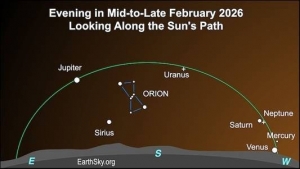
An astronomical event dubbed as the planet parade or planetary alignment, which is when—in this case, four—planets are visible to the naked eye in the evening sky (Mars, Jupiter, Saturn and Venus) as they move along the ecliptic says time.com.
Don’t forget to look up at the sky this weekend!
If you plan accordingly, you may be able to see a special celestial event—what’s known as a “planetary parade.”
Here’s what to know about this phenomenon.
What is a planetary parade?
This phenomenon happens when you can see several planets in the sky at once. In our solar system, planets orbit the Sun in the same plane, so on occasions when multiple planets’ paths around the Sun align, they may look, to us, like they’re “bunched together in the sky,” according to NASA.
“When this happens, it looks like the planets have roughly formed a line from our vantage point on Earth,” NASA explains on its website.
This weekend, six planets will line up in this way: Mercury, Venus, Jupiter, Saturn, Uranus, and Neptune, according to the Farmers’ Almanac.
Is a planetary parade rare?
It’s not unusual to be able to see a few planets in the sky at once; the Farmers’ Almanac reports that planetary parades typically occur every year.
But experts say that seeing as many as six planets in a parade is less common.
“While it’s fairly common to spot four or five planets at the same time, seeing six is much rarer,” Megan Argo, an astrophysicist at the University of Lancashire, told The Guardian.
When will the planetary parade be visible?
The most optimal time to see the planetary parade—when the planets will be lined up best—will be on Saturday, according to the Farmers’ Almanac.
How will you best be able to see the planetary parade?
The best way to see the planetary parade is to find a location with little to no light pollution and a clear view of the horizon, according to the Farmers’ Almanac. Make sure to check the weather beforehand—you’ll need a clear sky to get the best view.
Give your eyes enough time to adjust to the darkness. You should be able to see four of the planets—Mercury, Venus, Saturn, and Jupiter—just by looking up. But you’ll need some kind of optical assistance, like binoculars, to see the other two planets, Uranus and Neptune, according to NASA. Mercury may also be tricky to see with the naked eye, so binoculars could help you catch a better view of that planet too.
Share this article with friends!
Tags:
#planetary #parade #astrology #celestial #astronomical #Mars #Jupiter Saturn #Venus #starzpsychics