
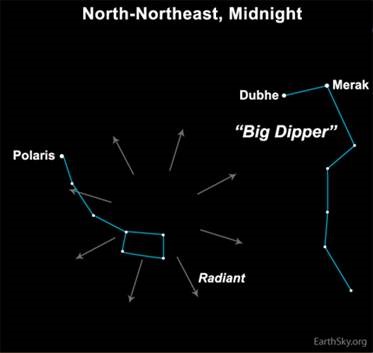
Image: Ursid meteors radiate from very far north on the sky’s dome,
near the Big and Little Dippers - earthsky.org
Tonight – December 17, 2018 – marks what might be the first night for the Ursid meteor shower. It usually peaks around the December sosltice and ends around December 26. Generally, the Ursids are a low-key affair, offering perhaps as many as 5-10 meteors per hour in a dark sky. In rare instances, bursts of 100 or more meteors per hour have been observed at times, over the past century.
But this year, the full moon falls on the same date as the expected peak of the Ursids: December 22, 2018. In an uncanny bit of bad timing, this meek shower also has to contend with harsh glare of the full moon.
The chart at the top of the page shows the Big and Little Dippers around 1 a.m. when the Big Dipper is well up in the north-northeast. That’s about the time you’ll want to start watching the shower. Again, the peak is the morning of December 22, but tomorrow morning or Friday morning (December 21 or 23) might yield some meteors as well.
All meteors in annual showers have radiant points on our sky’s dome, and the showers take their names from the constellations in which the radiant points lie. The Little Dipper asterism is in the constellation Ursa Minor the Lesser Bear. Hence, the Ursid meteor shower.
If you trace the paths of the rather slow-moving Ursid meteors backward, they appear to come from the section of sky marked by the Little Dipper star Kochab.
Although the Little Dipper is circumpolar (out all night) at northerly latitudes, the star Kochab sits below Polaris, the North Star, at nightfall. Kochab (and all the Little Dipper stars) circle Polaris in a counter-clockwise direction throughout the night, with this star reaching its high point for the night just before dawn. The higher the radiant climbs in your sky, the more meteors that you’re likely to see.
Ursid meteors radiate from near the star Kochab in the Little Dipper. The star Polaris is also part of the Little Dipper. Can’t find the Little Dipper? Use the Big Dipper! No matter what time of year you look, the two outer stars in the Big Dipper’s bowl always point to Polaris, which marks the end of the handle of the Little Dipper.
Bottom line: If you want to watch the Ursids, find a country location where you can camp out. Dress warmly! And plan to spend several hours reclining under a dark sky. The predawn hours are usually the most favorable – when the full moon is not obtruding on the show.
near the Big and Little Dippers - earthsky.org
Tonight – December 17, 2018 – marks what might be the first night for the Ursid meteor shower. It usually peaks around the December sosltice and ends around December 26. Generally, the Ursids are a low-key affair, offering perhaps as many as 5-10 meteors per hour in a dark sky. In rare instances, bursts of 100 or more meteors per hour have been observed at times, over the past century.
But this year, the full moon falls on the same date as the expected peak of the Ursids: December 22, 2018. In an uncanny bit of bad timing, this meek shower also has to contend with harsh glare of the full moon.
The chart at the top of the page shows the Big and Little Dippers around 1 a.m. when the Big Dipper is well up in the north-northeast. That’s about the time you’ll want to start watching the shower. Again, the peak is the morning of December 22, but tomorrow morning or Friday morning (December 21 or 23) might yield some meteors as well.
All meteors in annual showers have radiant points on our sky’s dome, and the showers take their names from the constellations in which the radiant points lie. The Little Dipper asterism is in the constellation Ursa Minor the Lesser Bear. Hence, the Ursid meteor shower.
If you trace the paths of the rather slow-moving Ursid meteors backward, they appear to come from the section of sky marked by the Little Dipper star Kochab.
Although the Little Dipper is circumpolar (out all night) at northerly latitudes, the star Kochab sits below Polaris, the North Star, at nightfall. Kochab (and all the Little Dipper stars) circle Polaris in a counter-clockwise direction throughout the night, with this star reaching its high point for the night just before dawn. The higher the radiant climbs in your sky, the more meteors that you’re likely to see.
Ursid meteors radiate from near the star Kochab in the Little Dipper. The star Polaris is also part of the Little Dipper. Can’t find the Little Dipper? Use the Big Dipper! No matter what time of year you look, the two outer stars in the Big Dipper’s bowl always point to Polaris, which marks the end of the handle of the Little Dipper.
Bottom line: If you want to watch the Ursids, find a country location where you can camp out. Dress warmly! And plan to spend several hours reclining under a dark sky. The predawn hours are usually the most favorable – when the full moon is not obtruding on the show.