
La Marseillaise" is the national anthem of France according to Wikipedia. The song was written in 1792 by Claude Joseph Rouget de Lisle in Strasbourg after the declaration of war by France against Austria, and was originally titled "Chant de guerre pour l'Armée du Rhin" ("War Song for the Rhine Army") and today is its birthday.
The Marseillaise was a revolutionary song, an anthem to freedom, a patriotic call to mobilize all the citizens and an exhortation to fight against tyranny and foreign invasion. The French National Convention adopted it as the Republic's anthem in 1795. It acquired its nickname after being sung in Paris by volunteers from Marseille marching to the capital. The song is the first example of the "European march" anthemic style. The anthem's evocative melody and lyrics have led to its widespread use as a song of revolution and its incorporation into many pieces of classical and popular music.
As the French Revolution continued, the monarchies of Europe became concerned that revolutionary fervor would spread to their countries. The War of the First Coalition was an effort to stop the revolution, or at least contain it to France. Initially, the French army did not distinguish itself, and Coalition armies invaded France. On 25 April 1792, baron Philippe-Frédéric de Dietrich, the mayor of Strasbourg, requested his guest Rouget de Lisle compose a song "that will rally our soldiers from all over to defend their homeland that is under threat". That evening, Rouget de Lisle wrote "Chant de guerre pour l'Armée du Rhin" (English: "War Song for the Army of the Rhine"), and dedicated the song to Marshal Nicolas Luckner, a Bavarian in French service from Cham. A plaque on the building on Place Broglie where De Dietrich's house once stood commemorates the event.
The melody soon became the rallying call to the French Revolution and was adopted as "La Marseillaise" after the melody was first sung on the streets by volunteers (fédérés in French) from Marseille by the end of May. These fédérés awere making their entrance into the city of Paris on 30 July 1792 after a young volunteer from Montpellier called François Mireur had sung it at a patriotic gathering in Marseille, and the troops adopted it as the marching song of the National Guard of Marseille. A newly graduated medical doctor, Mireur later became a general under Napoléon Bonaparte and died in Egypt at age 28.
The song's lyric reflects the invasion of France by foreign armies (from Prussia and Austria) that were under way when it was written. Strasbourg itself was attacked just a few days later. The invading forces were repulsed from France following their defeat in the Battle of Valmy. As the vast majority of Alsatians did not speak French, a German version ("Auf, Brüder, auf dem Tag entgegen") was published in October 1792 in Colmar.
The Convention accepted it as the French national anthem in a decree passed on 14 July 1795, making it France's first anthem. It later lost this status under Napoleon I, and the song was banned outright by Louis XVIII and Charles X, only being re-instated briefly after the July Revolution of 1830. During Napoleon I's reign, "Veillons au Salut de l'Empire" was the unofficial anthem of the regime, and in Napoleon III's reign, it was "Partant pour la Syrie". During the nineteenth and early twentieth centuries, "La Marseillaise" was recognised as the anthem of the international revolutionary movement; as such, it was adopted by the Paris Commune in 1871, albeit with new lyrics under the title "La marseillaise de la Commune". Eight years later, in 1879, it was restored as France's national anthem, and has remained so ever since.
The United States Library of Congress holds the following English translation.
Ye sons of France, awake to glory,
Hark, hark! what myriads bid you rise!
Your children, wives and white-haired grandsires.
Behold their tears and hear their cries! (repeat)
Shall hateful tyrants, mischiefs breeding,
With hireling hosts, a ruffian band,
Affright and desolate the land,
While peace and liberty lie bleeding?
To arms, to arms, ye brave!
The avenging sword unsheath,
March on, march on!
All hearts resolv'd
On victory or death!
Now, now, the dangerous storm is rolling
Which treacherous kings confederate raise!
The dogs of war, let loose, are howling,
And lo! our fields and cities blaze! (repeat)
alt: And lo! our homes will soon invade!
And shall we basely view the ruin
While lawless force with guilty stride
Spreads desolation far and wide
With crimes and blood his hands embruing?
To arms, to arms, ye brave!...
With luxury and pride surrounded
The vile insatiate despots dare,
Their thirst of power and gold unbounded,
To mete and vend the light and air! (repeat)
Like beasts of burden would they load us,
Like gods would bid their slaves adore,
But man is man, and who is more?
Then shall they longer lash and goad us?
To arms, to arms, ye brave!...
O Liberty, can man resign thee
Once having felt thy generous flame?
Can dungeons, bolts or bars confine thee
Or whips thy noble spirit tame? (repeat)
Too long the world has wept, bewailing
That falsehood's dagger tyrants wield,
But freedom is our sword and shield,
And all their arts are unavailing.
To arms, to arms, ye brave!...
The War whoop of anarchy, the Marseillais Hymn, is to my ear, I must confess, independently of all moral association, a most dismal, flat, and unpleasing ditty: and to any ear it is at any rate a long winded and complicated one. In the instance of a melody so mischievous in its application, it is a fortunate incident, if, in itself, it should be doomed neither in point of universality, nor permanence, to gain equal hold on the affections of the people.
Valéry Giscard d'Estaing, a former President of France, has said that it is ridiculous to sing about drenching French fields with impure Prussian blood as a German Chancellor takes the salute in Paris. A 1992 campaign to change the words of the song involving more than 100 prominent French citizens, including Danielle Mitterrand, wife of then-President François Mitterrand, was unsuccessful.
The historian Simon Schama discussed La Marseillaise on BBC Radio 4's Today programme on 17 November 2015 (in the immediate aftermath of the Paris attacks), saying it was "... the great example of courage and solidarity when facing danger; that's why it is so invigorating, that's why it really is the greatest national anthem in the world, ever. Most national anthems are pompous, brassy, ceremonious, but this is genuinely thrilling. Very important in the song ... is the line before us is tyranny, the bloody standard of tyranny has risen. There is no more ferocious tyranny right now than ISIS, so it's extremely easy for the tragically and desperately grieving French to identify with that".
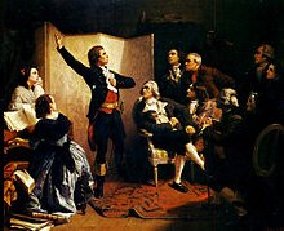
Image: Rouget de Lisle, composer of the Marseillaise, sings it for the first time in 1792
The Marseillaise was a revolutionary song, an anthem to freedom, a patriotic call to mobilize all the citizens and an exhortation to fight against tyranny and foreign invasion. The French National Convention adopted it as the Republic's anthem in 1795. It acquired its nickname after being sung in Paris by volunteers from Marseille marching to the capital. The song is the first example of the "European march" anthemic style. The anthem's evocative melody and lyrics have led to its widespread use as a song of revolution and its incorporation into many pieces of classical and popular music.
As the French Revolution continued, the monarchies of Europe became concerned that revolutionary fervor would spread to their countries. The War of the First Coalition was an effort to stop the revolution, or at least contain it to France. Initially, the French army did not distinguish itself, and Coalition armies invaded France. On 25 April 1792, baron Philippe-Frédéric de Dietrich, the mayor of Strasbourg, requested his guest Rouget de Lisle compose a song "that will rally our soldiers from all over to defend their homeland that is under threat". That evening, Rouget de Lisle wrote "Chant de guerre pour l'Armée du Rhin" (English: "War Song for the Army of the Rhine"), and dedicated the song to Marshal Nicolas Luckner, a Bavarian in French service from Cham. A plaque on the building on Place Broglie where De Dietrich's house once stood commemorates the event.
The melody soon became the rallying call to the French Revolution and was adopted as "La Marseillaise" after the melody was first sung on the streets by volunteers (fédérés in French) from Marseille by the end of May. These fédérés awere making their entrance into the city of Paris on 30 July 1792 after a young volunteer from Montpellier called François Mireur had sung it at a patriotic gathering in Marseille, and the troops adopted it as the marching song of the National Guard of Marseille. A newly graduated medical doctor, Mireur later became a general under Napoléon Bonaparte and died in Egypt at age 28.
The song's lyric reflects the invasion of France by foreign armies (from Prussia and Austria) that were under way when it was written. Strasbourg itself was attacked just a few days later. The invading forces were repulsed from France following their defeat in the Battle of Valmy. As the vast majority of Alsatians did not speak French, a German version ("Auf, Brüder, auf dem Tag entgegen") was published in October 1792 in Colmar.
The Convention accepted it as the French national anthem in a decree passed on 14 July 1795, making it France's first anthem. It later lost this status under Napoleon I, and the song was banned outright by Louis XVIII and Charles X, only being re-instated briefly after the July Revolution of 1830. During Napoleon I's reign, "Veillons au Salut de l'Empire" was the unofficial anthem of the regime, and in Napoleon III's reign, it was "Partant pour la Syrie". During the nineteenth and early twentieth centuries, "La Marseillaise" was recognised as the anthem of the international revolutionary movement; as such, it was adopted by the Paris Commune in 1871, albeit with new lyrics under the title "La marseillaise de la Commune". Eight years later, in 1879, it was restored as France's national anthem, and has remained so ever since.
Musical
Several musical antecedents have been cited for the melody:- Mozart's Allegro maestoso of Piano Concerto No. 25
- the credo of the fourth mass of Holtzmann of Mursberg
- the Oratorio Esther by Jean Baptiste Lucien Grison
- Recent researches have pointed out that the incipit of "Tema e variazioni in Do maggiore", composed in 1781 by Piedmontese violinist and composer Giovanni Battista Viotti bears a strong resemblance to the hymn
Lyrics
Only the first verse (and sometimes the fifth and sixth) and the first chorus are sung today in France. There are some slight historical variations in the lyrics of the song; the following is the version listed at the official website of the French Presidency. Verses sung in the contemporary version of the anthem are in bold.| Allons enfants de la Patrie, Le jour de gloire est arrivé! Contre nous de la tyrannie, L'étendard sanglant est levé, (bis) Entendez-vous dans les campagnes Mugir ces féroces soldats? Ils viennent jusque dans vos bras Égorger vos fils, vos compagnes! Aux armes, citoyens, Formez vos bataillons, Marchons, marchons! Qu'un sang impur Abreuve nos sillons! Que veut cette horde d'esclaves, De traîtres, de rois conjurés? Pour qui ces ignobles entraves, Ces fers dès longtemps préparés? (bis) Français, pour nous, ah! quel outrage Quels transports il doit exciter! C'est nous qu'on ose méditer De rendre à l'antique esclavage! Aux armes, citoyens... Quoi! des cohortes étrangères Feraient la loi dans nos foyers! Quoi! Ces phalanges mercenaires Terrasseraient nos fiers guerriers! (bis) Grand Dieu! Par des mains enchaînées Nos fronts sous le joug se ploieraient De vils despotes deviendraient Les maîtres de nos destinées! Aux armes, citoyens... Tremblez, tyrans et vous perfides L'opprobre de tous les partis, Tremblez! vos projets parricides Vont enfin recevoir leurs prix! (bis) Tout est soldat pour vous combattre, S'ils tombent, nos jeunes héros, La terre en produit de nouveaux, Contre vous tout prêts à se battre! Aux armes, citoyens... Français, en guerriers magnanimes, Portez ou retenez vos coups! Épargnez ces tristes victimes, À regret s'armant contre nous. (bis) Mais ces despotes sanguinaires, Mais ces complices de Bouillé, Tous ces tigres qui, sans pitié, Déchirent le sein de leur mère! Aux armes, citoyens... Amour sacré de la Patrie, Conduis, soutiens nos bras vengeurs Liberté, Liberté chérie, Combats avec tes défenseurs! (bis) Sous nos drapeaux que la victoire Accoure à tes mâles accents, Que tes ennemis expirants Voient ton triomphe et notre gloire! Aux armes, citoyens... (Couplet des enfants)[13] Nous entrerons dans la carrière Quand nos aînés n'y seront plus, Nous y trouverons leur poussière Et la trace de leurs vertus (bis) Bien moins jaloux de leur survivre Que de partager leur cercueil, Nous aurons le sublime orgueil De les venger ou de les suivre Aux armes, citoyens... |
Arise, children of the Fatherland, The day of glory has arrived! Against us tyranny's Bloody banner is raised, (repeat) Do you hear, in the countryside, The roar of those ferocious soldiers? They're coming right into your arms To cut the throats of your sons, your women! To arms, citizens, Form your battalions, Let's march, let's march! Let an impure blood Soak our fields! What does this horde of slaves, Of traitors and conspiratorial kings want? For whom are these vile chains, These long-prepared irons? (repeat) Frenchmen, for us, ah! What outrage What fury it must arouse! It is us they dare plan To return to the old slavery! To arms, citizens... What! Foreign cohorts Would make the law in our homes! What! These mercenary phalanxes Would strike down our proud warriors! (repeat) Great God! By chained hands Our brows would yield under the yoke Vile despots would have themselves The masters of our destinies! To arms, citizens... Tremble, tyrants and you traitors The shame of all parties, Tremble! Your parricidal schemes Will finally receive their reward! (repeat) Everyone is a soldier to combat you If they fall, our young heroes, The earth will produce new ones, Ready to fight against you! To arms, citizens... Frenchmen, as magnanimous warriors, Bear or hold back your blows! Spare those sorry victims, Who arm against us with regret. (repeat) But not these bloodthirsty despots, These accomplices of Bouillé, All these tigers who, mercilessly, Rip their mother's breast! To arms, citizens... Sacred love of the Fatherland, Lead, support our avenging arms Liberty, cherished Liberty, Fight with thy defenders! (repeat) Under our flags, may victory Hurry to thy manly accents, May thy expiring enemies, See thy triumph and our glory! To arms, citizens... (Children's Verse) We shall enter the (military) career When our elders are no longer there, There we shall find their dust And the trace of their virtues (repeat) Much less keen to survive them Than to share their coffins, We shall have the sublime pride Of avenging or following them To arms, citizens... |
Ye sons of France, awake to glory,
Hark, hark! what myriads bid you rise!
Your children, wives and white-haired grandsires.
Behold their tears and hear their cries! (repeat)
Shall hateful tyrants, mischiefs breeding,
With hireling hosts, a ruffian band,
Affright and desolate the land,
While peace and liberty lie bleeding?
To arms, to arms, ye brave!
The avenging sword unsheath,
March on, march on!
All hearts resolv'd
On victory or death!
Now, now, the dangerous storm is rolling
Which treacherous kings confederate raise!
The dogs of war, let loose, are howling,
And lo! our fields and cities blaze! (repeat)
alt: And lo! our homes will soon invade!
And shall we basely view the ruin
While lawless force with guilty stride
Spreads desolation far and wide
With crimes and blood his hands embruing?
To arms, to arms, ye brave!...
With luxury and pride surrounded
The vile insatiate despots dare,
Their thirst of power and gold unbounded,
To mete and vend the light and air! (repeat)
Like beasts of burden would they load us,
Like gods would bid their slaves adore,
But man is man, and who is more?
Then shall they longer lash and goad us?
To arms, to arms, ye brave!...
O Liberty, can man resign thee
Once having felt thy generous flame?
Can dungeons, bolts or bars confine thee
Or whips thy noble spirit tame? (repeat)
Too long the world has wept, bewailing
That falsehood's dagger tyrants wield,
But freedom is our sword and shield,
And all their arts are unavailing.
To arms, to arms, ye brave!...
Additional verses
These verses were omitted from the national anthem.| Dieu de clémence et de justice Vois nos tyrans, juge nos coeurs Que ta bonté nous soit propice Défends-nous de ces oppresseurs (bis) Tu règnes au ciel et sur terre Et devant Toi, tout doit fléchir De ton bras, viens nous soutenir Toi, grand Dieu, maître du tonnerre. Aux armes, citoyens... Peuple français, connais ta gloire; Couronné par l'Égalité, Quel triomphe, quelle victoire, D'avoir conquis la Liberté! (bis) Le Dieu qui lance le tonnerre Et qui commande aux éléments, Pour exterminer les tyrans, Se sert de ton bras sur la terre. Aux armes, citoyens... Nous avons de la tyrannie Repoussé les derniers efforts; De nos climats, elle est bannie; Chez les Français les rois sont morts. (bis) Vive à jamais la République! Anathème à la royauté! Que ce refrain, partout porté, Brave des rois la politique. Aux armes, citoyens... La France que l'Europe admire A reconquis la Liberté Et chaque citoyen respire Sous les lois de l'Égalité; (bis) Un jour son image chérie S'étendra sur tout l'univers. Peuples, vous briserez vos fers Et vous aurez une Patrie! Aux armes, citoyens... Foulant aux pieds les droits de l'Homme, Les soldatesques légions Des premiers habitants de Rome Asservirent les nations. (bis) Un projet plus grand et plus sage Nous engage dans les combats Et le Français n'arme son bras Que pour détruire l'esclavage. Aux armes, citoyens... Oui! Déjà d'insolents despotes Et la bande des émigrés Faisant la guerre aux Sans-culottes Par nos armes sont altérés; (bis) Vainement leur espoir se fonde Sur le fanatisme irrité, Le signe de la Liberté Fera bientôt le tour du monde. Aux armes, citoyens... À vous ! Que la gloire environne, Citoyens, illustres guerriers, Craignez, dans les champs de Bellone, Craignez de flétrir vos lauriers! (bis) Aux noirs soupçons inaccessibles Envers vos chefs, vos généraux, Ne quittez jamais vos drapeaux, Et vous resterez invincibles. Aux armes, citoyens... (Couplet des enfants) Enfants, que l'Honneur, la Patrie Fassent l'objet de tous nos vœux! Ayons toujours l'âme nourrie Des feux qu'ils inspirent tous deux. (bis) Soyons unis! Tout est possible; Nos vils ennemis tomberont, Alors les Français cesseront De chanter ce refrain terrible: Aux armes, citoyens... |
God of mercy and justice See our tyrants, judge our hearts Thy goodness be with us Defend us from these oppressors (repeat) You reign in heaven and on earth And before You all must bend In your arms, come support us You Great God, Lord of the thunder. To arms, citizens... French people know thy glory Crowned by Equality, What a triumph, what a victory, To have won Freedom! (repeat) The God who throws thunder And who commands the elements, To exterminate the tyrants Uses your arm on the ground. To arms, citizens... Of tyranny, we have Rebuffed the final efforts; It is banished from our climes; In France the kings are dead. (repeat) Forever live the Republic! Anathema to royalty! May this refrain sung everywhere, Defy the politics of kings. To arms, citizens... France that Europe admires Has regained Liberty And every citizen breathes Under the laws of Equality, (repeat) One day its beloved image Will extend throughout the universe. People, you will break your chains And you will have a Fatherland! To arms, citizens... Trampling on the rights of man, soldierly legions The first inhabitants of Rome enslave nations. (repeat) A larger project and wiser We engage in battle And the Frenchman does not arm himself But to destroy slavery. To arms, citizens... Yes! Already insolent despots And the band of emigrants Waging war on the unclothed [lit. without-breeches] By our weapons are withered; (repeat) Vainly their hope is based On piqued fanaticism The sign of Liberty Will soon spread around the world. To arms, citizens... To you! Let glory surround Citizens, illustrious warriors, Fear in the fields of Bellona, Fear the sullying of your laurels! (repeat) As for dark unfounded suspicions Towards your leaders, your generals, Never leave your flags, And you will remain invincible. To arms, citizens... (Children's Verse) Children, let Honour and Fatherland be the object of all our wishes! Let us always have souls nourished With fires that might inspire both. (repeat) Let us be united! Anything is possible; Our vile enemies will fall, Then the French will cease To sing this fierce refrain: To arms, citizens... |
Historical use in Russia
In Russia, La Marseillaise was used as a republican revolutionary anthem by those who knew French starting in the 18th century, almost simultaneously with its adoption in France. In 1875 Peter Lavrov, a narodist revolutionary and theorist, wrote a Russian-language text (not a translation of the French one) to the same melody. This "Worker's Marseillaise" became one of the most popular revolutionary songs in Russia and was used in the Revolution of 1905. After the February Revolution of 1917, it was used as the semi-official national anthem of the new Russian republic. Even after the October Revolution, it remained in use for a while alongside The Internationale.Criticism and controversy
The English philosopher and reformer Jeremy Bentham, who was declared an honorary citizen of France in 1791 in acknowledgement of his sympathies for the ideals of the French Revolution, was not enamoured of La Marseillaise. Contrasting its qualities with the "beauty" and "simplicity" of "God Save the King", he wrote in 1796:The War whoop of anarchy, the Marseillais Hymn, is to my ear, I must confess, independently of all moral association, a most dismal, flat, and unpleasing ditty: and to any ear it is at any rate a long winded and complicated one. In the instance of a melody so mischievous in its application, it is a fortunate incident, if, in itself, it should be doomed neither in point of universality, nor permanence, to gain equal hold on the affections of the people.
Valéry Giscard d'Estaing, a former President of France, has said that it is ridiculous to sing about drenching French fields with impure Prussian blood as a German Chancellor takes the salute in Paris. A 1992 campaign to change the words of the song involving more than 100 prominent French citizens, including Danielle Mitterrand, wife of then-President François Mitterrand, was unsuccessful.
The historian Simon Schama discussed La Marseillaise on BBC Radio 4's Today programme on 17 November 2015 (in the immediate aftermath of the Paris attacks), saying it was "... the great example of courage and solidarity when facing danger; that's why it is so invigorating, that's why it really is the greatest national anthem in the world, ever. Most national anthems are pompous, brassy, ceremonious, but this is genuinely thrilling. Very important in the song ... is the line before us is tyranny, the bloody standard of tyranny has risen. There is no more ferocious tyranny right now than ISIS, so it's extremely easy for the tragically and desperately grieving French to identify with that".
Image: Rouget de Lisle, composer of the Marseillaise, sings it for the first time in 1792